
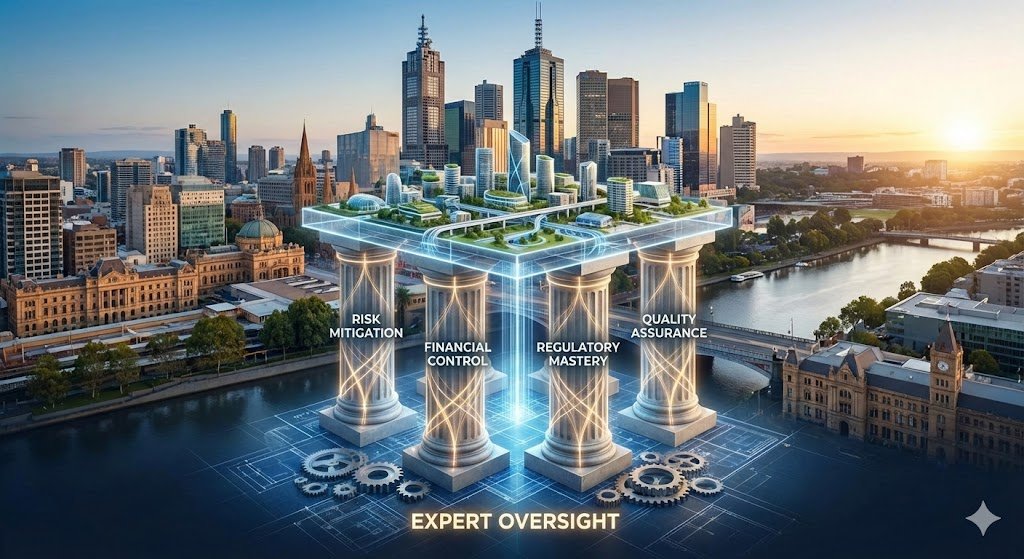
The Australian skyline is a living entity, constantly evolving and reshaping itself in response to economic drivers, population growth, and architectural innovation. From the bustling, crane-filled horizons of Melbourne and Sydney to the critical infrastructure projects connecting our regional hubs, the nation is in a perpetual state of development. This sector serves as the backbone of the national economy, driving employment, innovation, and community growth. However, the path from a visionary blueprint to a tangible structure is rarely a straight line. It is a complex journey fraught with logistical hurdles, regulatory labyrinths, and financial risks.
In today’s high-stakes environment, the difference between a landmark success and a costly failure often hinges on a single, critical variable: the quality of oversight. As projects grow in scale and complexity, the traditional methods of management are no longer sufficient. Developers, investors, and stakeholders are increasingly recognizing that expert construction project management is not just a service—it is a strategic necessity. This article explores the multifaceted landscape of the modern Australian built environment and why professional consultancy is the keystone of resilient, successful development.
The Evolving Landscape of Australian Construction
The construction industry in Australia is undergoing a metamorphosis of unprecedented scale. We are moving away from simple, functional builds towards integrated, mixed-use precincts that demand a sophisticated approach to design and execution. The “built environment” is no longer just about erecting walls and roofs; it is about creating sustainable ecosystems that interact seamlessly with existing infrastructure and communities.
This evolution brings with it a unique set of challenges. Supply chain volatility, exacerbated by global events, has made material procurement a logistical nightmare. Labor shortages in key skilled trades are driving up costs and stretching timelines. Furthermore, the push for “green building” and carbon neutrality is forcing a re-evaluation of materials and methodologies. In this volatile climate, the steady hand of a seasoned consultant is invaluable. They act as the navigator, steering the project through turbulent waters and ensuring that the initial vision is preserved despite external pressures.
Strategic Risk Mitigation: The First Line of Defense
One of the primary functions of high-level consultancy is risk management. In the context of major infrastructure or commercial development, risk comes in many forms: financial, operational, legal, and reputational. A reactive approach—fixing problems as they arise—is a recipe for disaster. What is required is a proactive, predictive strategy that identifies potential pitfalls before ground is even broken.
This is where expert construction project management truly shines. By leveraging decades of industry experience and data-driven insights, professional managers can conduct comprehensive feasibility studies and risk assessments. They analyze the project from every angle, identifying potential bottlenecks in the supply chain, conflicting regulatory requirements, or design flaws that could lead to costly variations down the track.
For instance, consider the complexities of building in a dense urban environment like Melbourne’s CBD. There are heritage overlays to consider, traffic management plans to coordinate, and the intricate logistics of maneuvering heavy machinery in tight spaces. A generic management approach might overlook the nuance of a specific council regulation, leading to work stoppages and fines. In contrast, a specialist consultant anticipates these hurdles, engaging with authorities early and developing contingency plans that keep the wheels turning.
The Financial Imperative: Cost Control vs. Value Engineering
There is a pervasive myth in the industry that hiring top-tier project management consultants is an added expense. In reality, it is an investment that pays for itself many times over. The cost of a project is not determined solely by the price of concrete and steel; it is determined by the efficiency of the process. Delays cost money. Rework costs money. Legal disputes cost money.
Effective financial management in construction goes beyond simple bookkeeping. It involves the strategic application of “Value Engineering.” This is not about cutting corners or choosing cheaper, inferior materials. Rather, it is about optimizing the design and construction process to achieve the best possible function and quality at the lowest necessary cost.
Experienced consultants scrutinize every line item of a budget. They challenge assumptions and propose alternatives. Is there a different structural system that offers the same strength but can be erected faster? Is there a locally sourced material that eliminates the risk of shipping delays? By asking these questions, they unlock value that often remains hidden to those less experienced in the intricacies of the trade.
Moreover, strict contract administration is vital. The Australian construction sector is litigious, and poorly defined scopes or ambiguous contract terms are a breeding ground for disputes. A professional management team ensures that all contracts are watertight, that variations are rigorously assessed, and that progress payments are inextricably linked to verified milestones. This financial discipline protects the client’s capital and ensures that the project remains commercially viable from start to finish.
Navigating the Regulatory Labyrinth
Australia boasts some of the most stringent building codes and safety regulations in the world. While these standards are essential for ensuring the safety and longevity of our built environment, they can be a minefield for the uninitiated. The regulatory landscape is also constantly shifting, with frequent updates to the National Construction Code (NCC) and state-specific planning schemes.
Compliance is not a box-ticking exercise; it is a fundamental component of project integrity. Non-compliance can lead to disastrous consequences, ranging from forced demolition and retrofitting to severe legal penalties and reputational ruin.
A dedicated project management team acts as the guardian of compliance. They maintain a deep, up-to-the-minute understanding of all relevant legislation, from fire safety standards to disability access requirements. They coordinate with building surveyors, town planners, and council representatives to ensure that every aspect of the design and build meets the letter and the spirit of the law.
This oversight extends to Occupational Health and Safety (OHS). The safety of workers and the public is paramount. Professional managers implement rigorous safety protocols, ensuring that site culture prioritizes well-being. They conduct regular audits and enforce strict adherence to safety standards, mitigating the risk of accidents that could halt progress and cause human tragedy.
The Sustainability Mandate: Building for the Future
Sustainability is no longer a buzzword; it is a mandate. Investors, tenants, and the broader community are demanding buildings that are environmentally responsible and energy-efficient. The Australian property market is seeing a distinct “green premium,” where sustainable assets command higher valuations and rental yields.
However, delivering a 5-Star Green Star or NABERS-rated building requires a high level of technical expertise. It involves the integration of complex systems—solar power, rainwater harvesting, passive thermal design, and smart building management systems. It requires the sourcing of low-carbon materials and the implementation of waste-reduction strategies during construction.
Implementing expert construction project management allows developers to navigate the complexities of sustainable design without compromising on aesthetics or functionality. Consultants can advise on the latest green technologies and lifecycle costing, demonstrating how an upfront investment in energy efficiency can result in massive operational savings over the lifespan of the building. They bridge the gap between the sustainability consultant’s vision and the builder’s reality, ensuring that green initiatives are practical, buildable, and cost-effective.
The Human Element: Stakeholder Management and Communication
Construction is, at its core, a human endeavor. A major project involves a vast web of stakeholders: the client, the architect, engineers, the head contractor, subcontractors, suppliers, local residents, and government authorities. Each of these groups has different priorities, different timelines, and different ways of working.
Misalignment between these stakeholders is one of the most common causes of project failure. If the architect designs something the builder cannot build, or if the client’s expectations are not communicated clearly to the design team, conflict is inevitable.
The project manager acts as the conductor of this orchestra. They serve as the central point of truth, facilitating clear, consistent communication between all parties. They translate the technical jargon of the engineer into plain English for the investor, and they convey the commercial constraints of the client to the design team.
Effective stakeholder management also involves managing the expectations of the community. In urban infill projects, neighbor relations can make or break a schedule. A professional management team engages with the community proactively, addressing concerns about noise, dust, and traffic before they escalate into formal complaints or protests. By fostering a spirit of collaboration rather than confrontation, they pave the way for a smoother delivery.
Quality Assurance: Beyond the Surface
In a booming market, there is always a temptation to rush. When deadlines are tight, quality is often the first casualty. We have seen too many examples in recent years of defects emerging in new builds—cracked foundations, leaking cladding, and compromised fireproofing. These defects not only destroy the value of the asset but also erode public trust in the industry.
Quality assurance cannot be an afterthought; it must be baked into the process from day one. It requires a rigorous inspection regime that goes far beyond the standard milestones. It involves checking the quality of materials before they arrive on site, monitoring workmanship during installation, and conducting exhaustive testing during the commissioning phase.
This is a key area where independent oversight is crucial. The builder’s priority is often speed; the project manager’s priority is integrity. By having an independent advocate on site who is solely focused on the client’s interests, you ensure that no corners are cut. This rigorous attention to detail ensures that the final product is not just visually impressive, but structurally sound and built to last for generations.
Conclusion: The Strategic Advantage
The narrative of Australia’s built environment is one of ambition and resilience. We are building higher, digging deeper, and reaching further than ever before. But as our ambitions grow, so too must the sophistication of our methods. The era of the “handshake deal” and the ad-hoc management style is over. The complexity of modern construction demands a level of precision and foresight that can only be provided by dedicated professionals.
Engaging expert construction project management is the single most effective way to de-risk a development. It provides the strategic framework required to navigate the volatile currents of the modern market. It ensures that costs are controlled, regulations are met, quality is guaranteed, and the vision is realized.
For developers and investors in Australia, the message is clear: the skyline is waiting, but it rewards only those who are prepared. By partnering with seasoned consultants who understand the intricacies of the local landscape, you are not just building a structure; you are building a legacy. Whether it is a boutique residential development in the inner suburbs or a sprawling industrial complex in the growth corridors, the blueprint for success begins with expert oversight. It is the bridge between the possible and the actual, ensuring that the physical fabric of our nation continues to reflect our highest aspirations.
Key Takeaways for Developers and Investors
- Early Engagement: Do not wait until the design is finalized to hire a project manager. Engaging them during the feasibility stage can save significant time and money by identifying risks early.
- Holistic View: Look for a consultancy that understands the entire lifecycle of a project, from planning and approvals to construction and asset handover.
- Local Knowledge: Ensure your management team has deep roots in the Australian market and understands the specific nuances of local councils and state regulations.
- Communication: Prioritize clear reporting and transparent communication channels. You cannot manage what you cannot measure or see.
In the dynamic world of Australian construction, the only constant is change. However, with the right team at the helm, change becomes an opportunity rather than a threat. It allows for innovation, adaptation, and ultimately, the creation of spaces that define the future of our cities.