
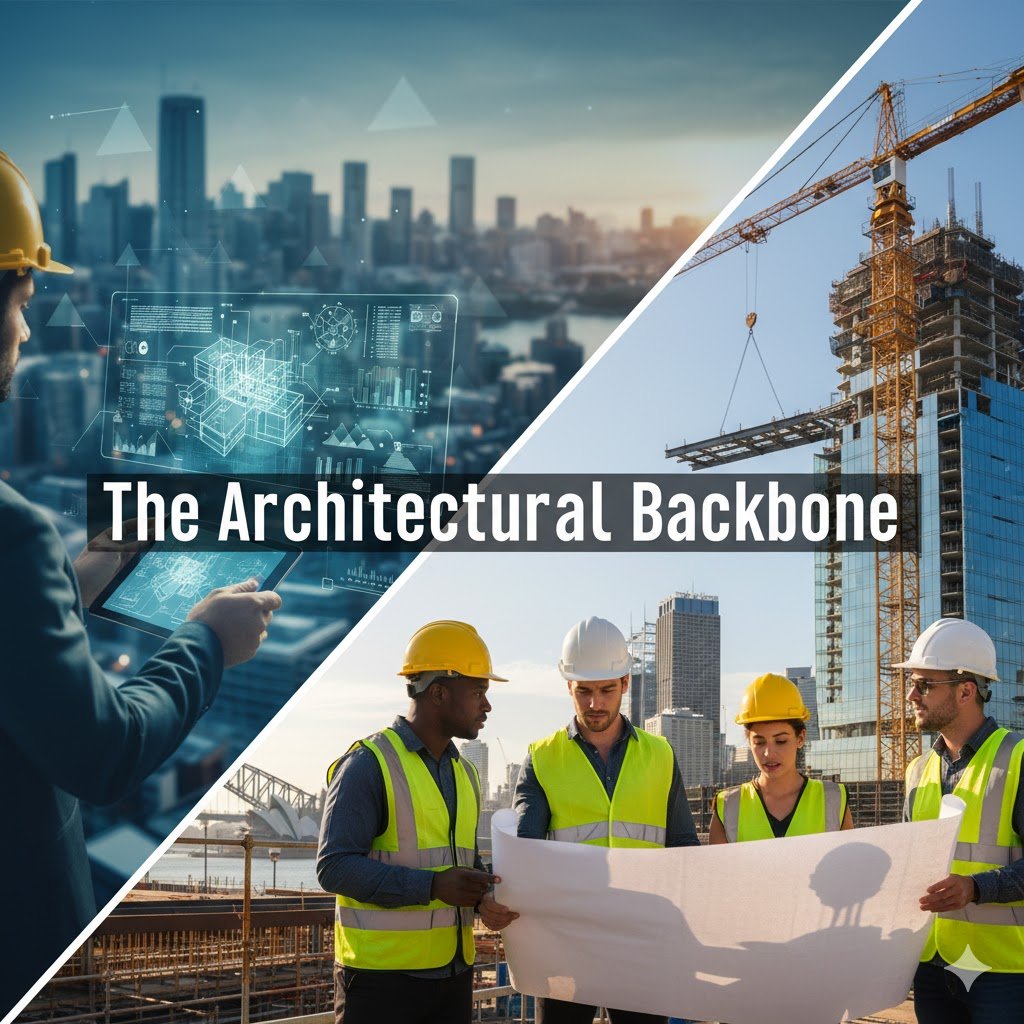
The Australian skyline is a narrative of ambition. From the shimmering glass towers of Melbourne’s Southbank to the sprawling infrastructure projects connecting the dusty red interior to the coast, the built environment is the physical manifestation of our national economic pulse. However, the path from a blueprint to a ribbon-cutting ceremony is no longer a linear progression of laying bricks and pouring concrete. It has become a high-stakes chess game played against a backdrop of volatile supply chains, shifting regulatory sands, and an urgent global mandate for sustainability.
In this complex ecosystem, the romantic image of the “master builder” has evolved. Today, success is not just about engineering prowess; it is about orchestral leadership. As we look toward the next decade of development, it becomes increasingly clear that the difference between a landmark success and a costly failure often lies in the quality of the strategic oversight applied from day one. This brings us to the heart of the modern industry: the indispensable value of professional guidance in navigating the chaotic waters of construction.
H2: Navigating the Complexities of the Modern Built Environment
The days of straightforward construction projects are largely behind us. In the current Australian market, developers and stakeholders are facing a “perfect storm” of challenges that threaten the viability of even the most well-funded initiatives. To understand the solution, we must first dissect the problem.
H3: The volatility of Material Costs and Supply Chains
Since the global disruptions of recent years, the cost of raw materials—steel, timber, concrete—has fluctuated wildly. A feasibility study conducted six months ago may be entirely obsolete today due to a sudden spike in the price of imported steel or a logistics bottleneck in a major shipping lane.
For a developer, this uncertainty is poison. Without a dynamic management strategy, budget blowouts are not just a risk; they are a probability. This is where the role of a dedicated consultancy becomes vital. It is not enough to simply react to price changes; one must anticipate them. Advanced procurement strategies, early contractor involvement, and rigid cost planning are essential tools that protect the bottom line. By locking in prices early or having flexible contingencies, expert managers ensure that a project remains financially viable even when the market wobbles.
H3: The Regulatory Maze
Australia boasts some of the most stringent building codes and safety regulations in the world. While this ensures the safety and quality of our structures, it presents a labyrinthine challenge for developers. From the intricacies of the National Construction Code (NCC) to local council zoning laws and environmental protection acts, the regulatory burden is immense.
A misstep here can lead to work stoppages, legal battles, and retroactive rectifications that bleed a project dry. Navigating this maze requires more than just legal advice; it requires practical, on-the-ground knowledge of how these regulations apply to the physical build. It requires a partner who can foresee compliance issues during the design phase, long before a shovel hits the ground.
H2: The Core Pillars of Success in Development
When we strip away the noise of the job site, the success of any major development relies on three things: time, cost, and quality. Balancing these competing forces is the “Iron Triangle” of the industry. However, maintaining this balance is impossible without a centralized nervous system directing the flow of information and resources. This is the specific domain of construction project management.
H3: Strategic Planning and Feasibility
The most critical phase of any construction project happens before the site is even fenced off. The pre-construction phase is where the project is won or lost. It involves deep-dive feasibility studies that look beyond simple arithmetic. Is the site geotechnically sound? What are the traffic management implications? How will local community sentiment affect planning approvals?
An expert management team runs these scenarios like a war game. They stress-test the schedule and the budget against worst-case scenarios. This strategic planning creates a roadmap that is robust enough to handle the inevitable surprises of construction. Without this level of foresight, a project is simply drifting, vulnerable to the first current that pushes it off course.
H3: Cost Management and Budget Control
There is a distinct difference between “bookkeeping” and “cost management.” Bookkeeping records what has been spent; cost management dictates what should be spent and controls the flow of capital to ensure maximum value. In an era of slim margins, value engineering—the art of maintaining function and quality while reducing cost—is a non-negotiable skill set.
This does not mean buying cheaper materials. It means optimizing designs to reduce waste, choosing construction methodologies that save time (and therefore labor costs), and negotiating contracts that share risk appropriately between the client and the contractor. Effective cost control is active, not passive. It involves constant auditing of progress claims and variations to ensure that every dollar spent contributes directly to the project’s objectives.
H2: Sustainability: More Than Just a Buzzword
Perhaps the most significant shift in the Australian construction landscape is the move toward sustainability. This is no longer driven solely by ethical concerns; it is driven by market demand and asset value. Commercial tenants are demanding high Green Star ratings to meet their own corporate social responsibility (CSR) goals, and residential buyers are looking for energy-efficient homes to combat rising utility costs.
H3: Integrating Green Practices
Implementing sustainability is not as simple as adding solar panels to the roof. It requires a holistic approach that considers the “embodied carbon” of the materials used, the thermal performance of the building envelope, and the lifecycle costs of the asset.
This introduces a new layer of complexity to the build. Sourcing recycled aggregate for concrete, managing waste diversion reports, and ensuring airtightness for passive cooling requires rigorous oversight. If these elements are not managed correctly, they can become expensive bottlenecks. However, when integrated smoothly into the project lifecycle, they add immense value to the final asset. This integration is a key responsibility of the modern project manager, who must act as the bridge between sustainability consultants and the trade contractors on the ground.
H2: Why Consultancy Matters in Risk Mitigation
Risk is inherent in construction. You are fighting gravity, weather, and human error. You cannot eliminate risk, but you can mitigate it. This is perhaps the strongest argument for engaging high-level consultancy services.
H3: The Art of Stakeholder Management
A major construction project has dozens of stakeholders: the client, the architect, the engineers, the local council, the neighbors, the future tenants, and the financiers. Each of these groups has different priorities and different definitions of success. Friction between them is inevitable.
An expert consultant acts as the diplomat and the translator. They translate the technical jargon of the engineer into financial implications for the client. They translate the aesthetic vision of the architect into practical instructions for the builder. By managing these relationships and keeping communication lines open and transparent, the consultant prevents small misunderstandings from festering into major disputes.
H3: Proactive Problem Solving
In the absence of strong leadership, problems on a construction site tend to cascade. A delay in the delivery of façade panels delays the window installation, which delays the internal fit-out, which delays the handover.
Experienced construction project management professionals operate with a “look-ahead” philosophy. They are constantly scanning the horizon for potential clashes. If the façade panels are delayed, they might re-sequence the internal works to keep the trades moving. If rain is forecast, they might accelerate the roofing works. This proactive agility is what saves weeks, sometimes months, on a program.
H2: The Future of Australian Construction
As we move further into the 2020s, the industry is teetering on the edge of a technological revolution. We are seeing the rise of Building Information Modelling (BIM) not just as a design tool, but as a facility management tool. We are seeing the early adoption of AI in scheduling and the increasing use of pre-fabricated modular components to speed up on-site assembly.
H3: Technology and Innovation
Adopting these new technologies carries its own risks. Being the “first mover” can be expensive if the technology fails. However, ignoring innovation leads to obsolescence. The role of the project manager is now evolving to include “technology integration.” They must advise clients on which innovations offer genuine return on investment and which are merely gimmicks.
For example, the use of drone technology for site surveys and progress reporting has revolutionized transparency. Clients can now see real-time, high-definition aerial views of their assets, providing a level of assurance that paper reports never could. Similarly, 5D BIM modelling (which adds the dimensions of time and cost to the 3D model) allows for incredibly accurate cash flow forecasting.
H2: Conclusion: The value of Partnership
Australia is a nation of builders. From our mining infrastructure to our expanding suburbs, we are constantly reshaping our environment. But as our ambitions grow taller and more complex, the mechanisms we use to achieve them must mature. The “she’ll be right” attitude of the past has no place in a multi-million dollar development where margins are tight and liabilities are high.
The success of future projects will not be defined solely by the architect’s vision or the builder’s labor. It will be defined by the invisible glue that holds the project together: the strategic oversight, the financial discipline, and the regulatory expertise provided by professional management.
Investing in high-quality construction project management is not an administrative cost; it is an insurance policy and a value generator. It is the assurance that your vision will be delivered not just in form, but in function and financial viability.
At Silver Fox Management, we understand that we are not just building structures; we are building the future of Australia’s cities. In a landscape defined by change and challenge, having a steady hand at the tiller is the only way to ensure that we reach our destination safely, efficiently, and successfully. Whether it is a boutique residential development or a large-scale commercial precinct, the principles remain the same: plan meticulously, manage rigorously, and lead with experience. This is the blueprint for the future of our built environment.